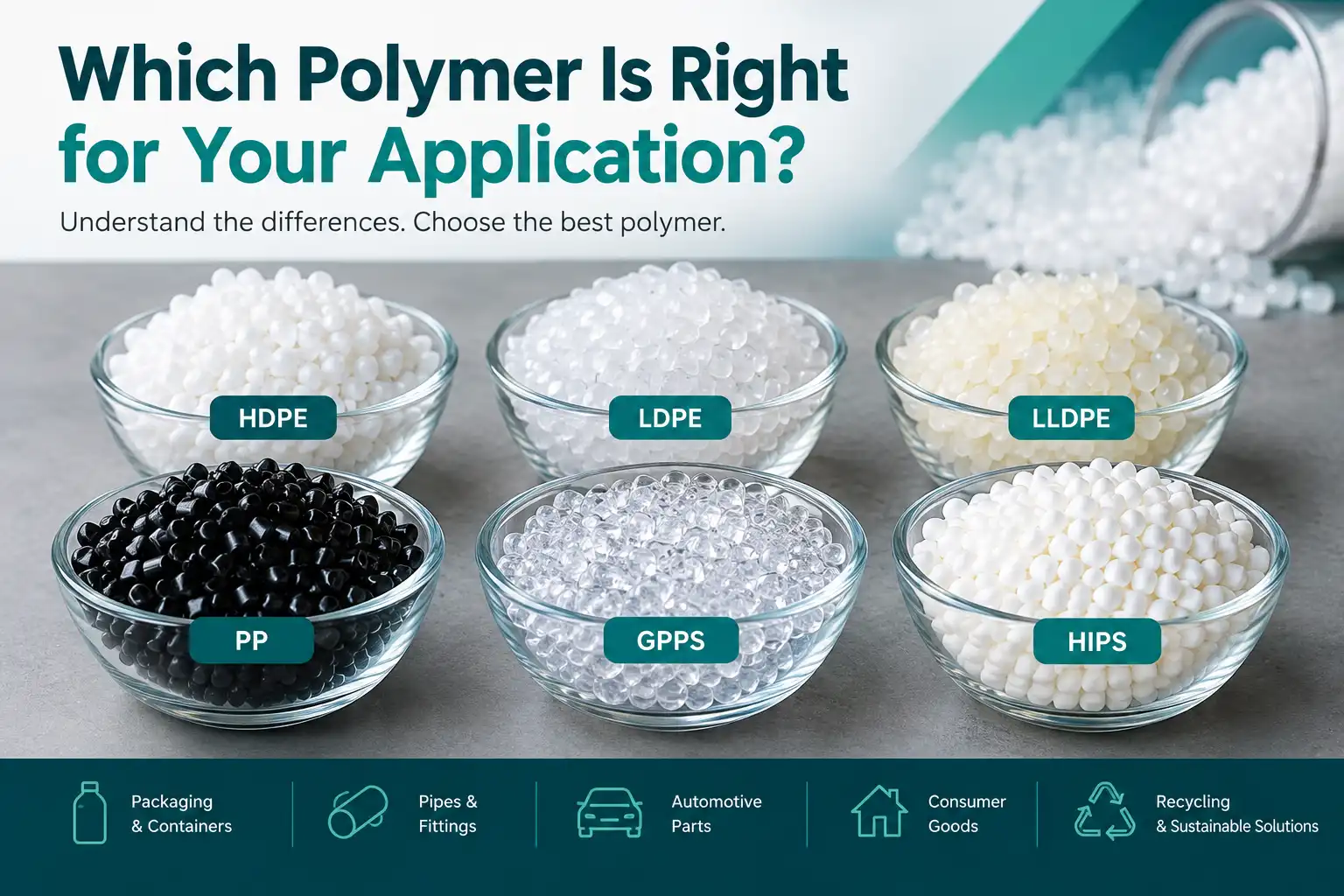

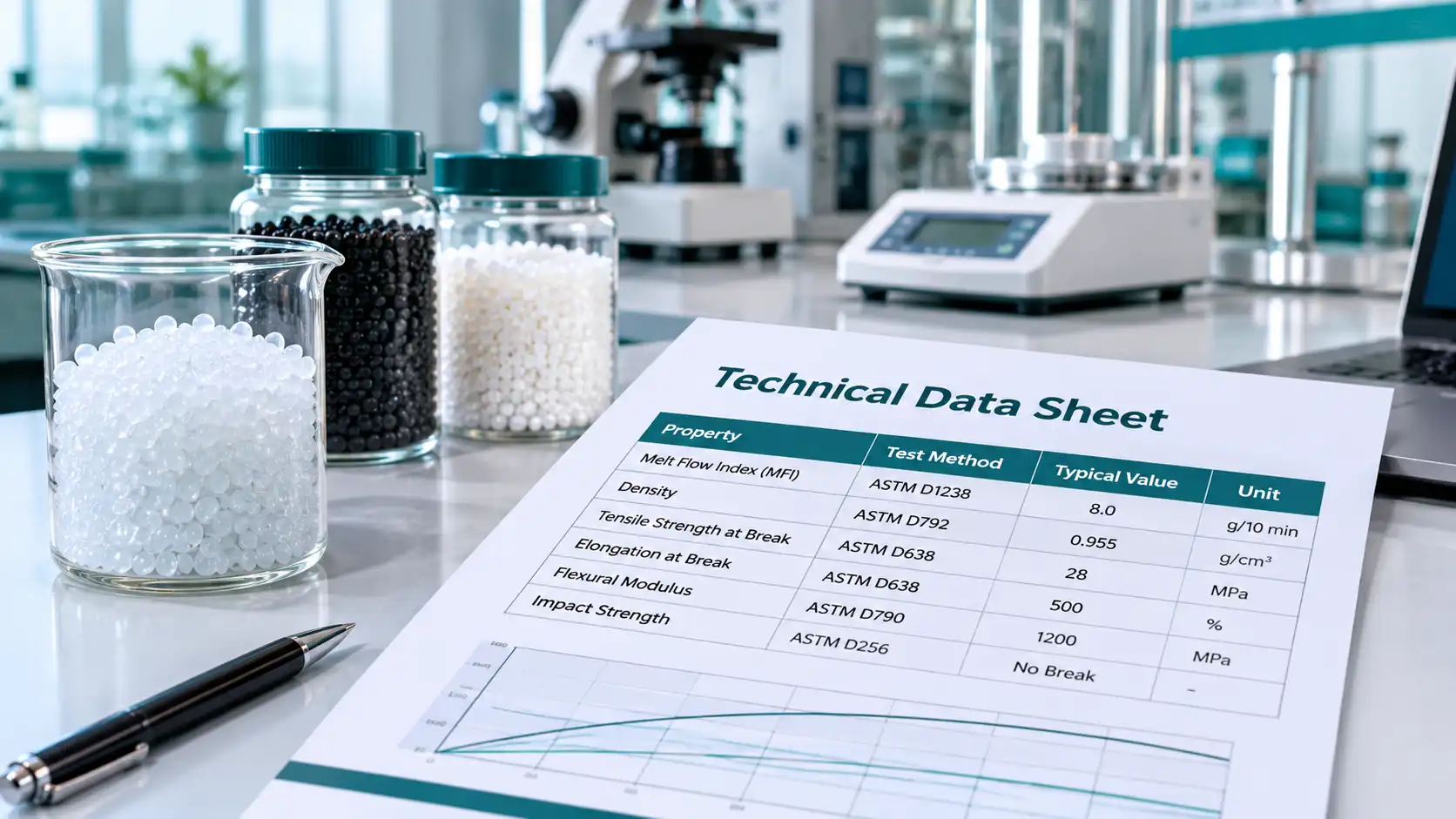
When purchasing plastic raw materials, understanding the material’s technical specifications is essential for selecting the right grade for your manufacturing process. Whether you are buying HDPE, LDPE, LLDPE, polypropylene (PP), or polystyrene (PS), a Technical Data Sheet (TDS) provides valuable information about the material’s properties, processing characteristics, and potential applications.
However, technical data sheets often contain abbreviations, laboratory test results, and technical values that can be confusing, especially for buyers comparing different polymer grades or suppliers.
In this guide, we explain how to read a polymer TDS, understand its most important parameters, and use technical specifications to make better purchasing decisions.
What Is a Polymer Technical Data Sheet (TDS)?
A Technical Data Sheet (TDS) is a document that describes the typical technical and physical properties of a polymer grade. It helps manufacturers, engineers, purchasing managers, and raw material buyers evaluate whether a material is suitable for a particular application.
A polymer TDS commonly includes:
- Melt Flow Rate (MFR or MFI)
- Density
- Tensile strength
- Elongation at break
- Flexural modulus
- Impact strength
- Thermal properties
- Processing recommendations
- Standard test methods
The information provided depends on the polymer type, grade, manufacturer, and intended application.
For example, an HDPE grade designed for injection molding may have different flow characteristics from an HDPE grade developed for pipe extrusion. Reading the TDS helps buyers understand these differences before selecting a material.
1. Melt Flow Rate (MFR or MFI)
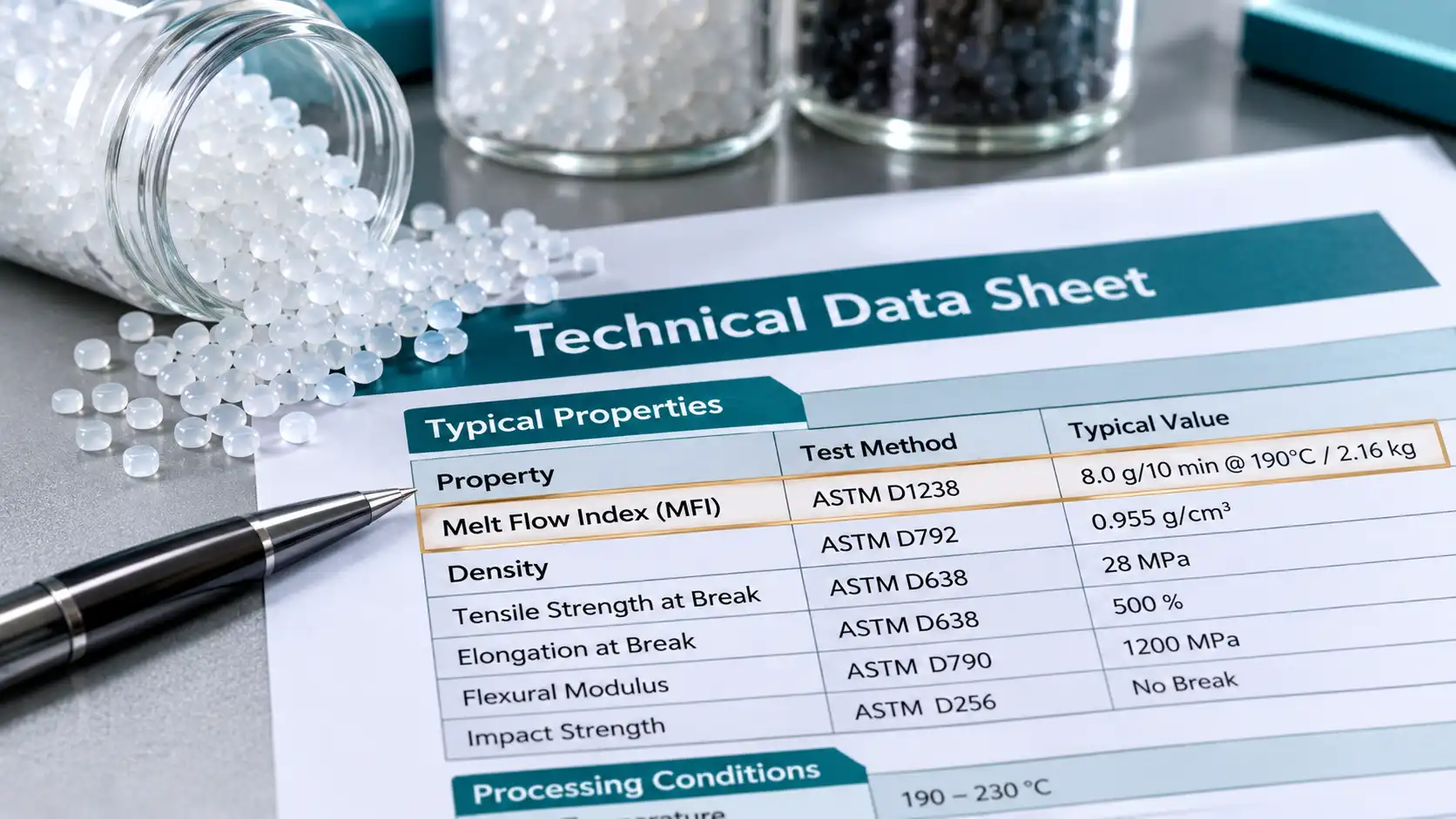
Melt Flow Rate, commonly called Melt Flow Index (MFI), is one of the most important parameters in a polymer TDS.
It measures the mass of molten polymer that flows through a standardized die under specified temperature and load conditions during a defined period. It is commonly expressed in grams per 10 minutes (g/10 min).
For example, a TDS might report:
Melt Flow Rate: 8 g/10 min at 190°C / 2.16 kg
This means that 8 grams of the material flowed through the test die in 10 minutes under the specified test conditions.
Why Is MFI Important?
MFI provides a useful indication of how easily a polymer flows during a standardized test. It helps manufacturers compare grades and assess their suitability for different processing methods.
In general, for comparable materials tested under the same conditions:
- Higher MFI: Often indicates easier flow and may be suitable for applications requiring higher melt flow.
- Lower MFI: Often indicates greater resistance to flow and may be suitable for applications requiring higher melt strength.
However, MFI alone does not determine a polymer’s viscosity under all processing conditions, its mechanical performance, or its suitability for a specific application.
MFI and Polymer Applications
Different manufacturing processes may require different flow characteristics.
| Application | Typical consideration |
| Injection molding | Flow must be suitable for filling the mold. |
| Film extrusion | Melt strength and flow behavior are important. |
| Pipe extrusion | Stable extrusion behavior and application-specific performance are essential. |
| Blow molding | Melt strength and resistance to deformation may be important. |
Important: Never compare MFI values without checking the test temperature, applied load, and test standard. For example, an MFI value measured at 190°C under a 2.16 kg load should not be directly compared with a value measured under different conditions.
2. Density
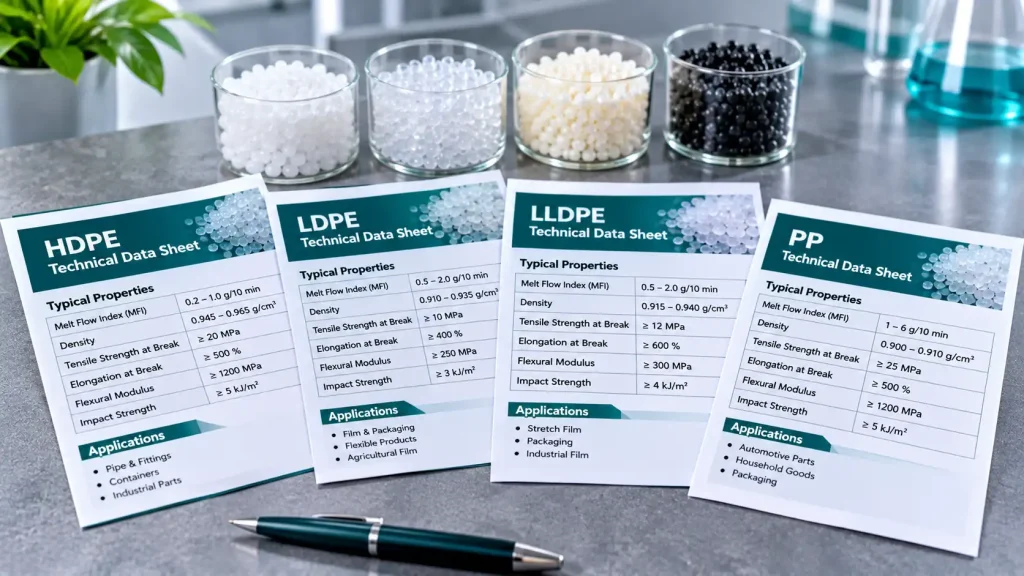
Density describes the mass of a material per unit volume. In polymer TDS documents, it is commonly expressed in grams per cubic centimeter (g/cm³) or kilograms per cubic meter (kg/m³).
For example:
Density: 0.955 g/cm³ at 23°C
Density is particularly important when evaluating polyethylene grades, including HDPE, LDPE, and LLDPE.
Why Does Density Matter?
Density can influence several material properties, including stiffness, crystallinity, and some mechanical and thermal characteristics. However, the exact relationship depends on the polymer structure, molecular weight, additives, and processing conditions.
In general:
- HDPE: Typically has a higher density than LDPE.
- LDPE: Typically has a lower density and a more branched molecular structure.
- LLDPE: Often combines flexibility with good tensile and puncture performance, depending on its grade and formulation.
Density is useful for comparing materials, but it should not be used as the only criterion for selecting a polymer.
For example, two polyethylene grades with similar densities may have significantly different processing behavior and mechanical properties.
3. Tensile Strength
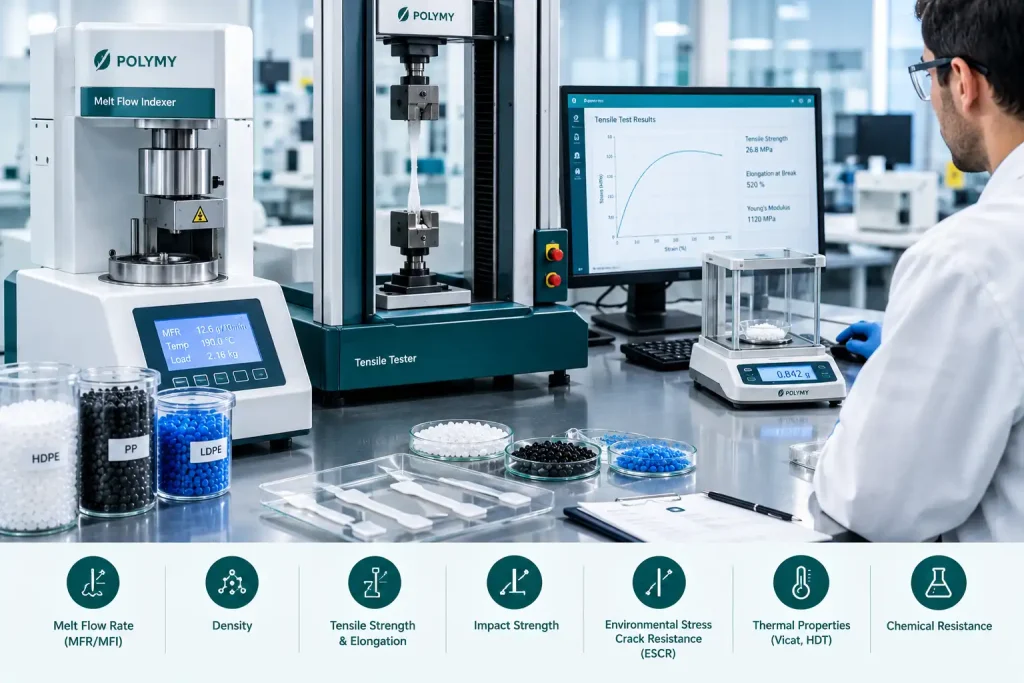
Tensile strength indicates how much tensile stress a material can withstand under specified test conditions before reaching a defined point, such as maximum stress or break.
It is usually expressed in megapascals (MPa).
A TDS may report tensile properties such as:
- Tensile strength at yield
- Tensile strength at break
- Tensile stress at a specified elongation
These values are not interchangeable. Always check which tensile property is being reported.
Why Is Tensile Strength Important?
Tensile properties help manufacturers assess a material’s mechanical performance.
They can be relevant when selecting polymers for:
- Plastic containers
- Industrial components
- Packaging products
- Pipes and fittings
- Film applications
For pressure pipes, however, a single tensile strength value is not enough to establish suitability. Long-term hydrostatic strength, applicable pipe standards, material classification, and the requirements of the finished product must also be considered.
When comparing two grades, make sure the values were obtained using comparable test methods and specimen conditions.
4. Elongation at Break
Elongation at break measures how much a specimen stretches before breaking, expressed as a percentage of its original length.
For example:
Elongation at Break: 500%
This means that, under the specified test conditions, the specimen reached a length corresponding to approximately six times its original gauge length before breaking.
Why Is Elongation Important?
Elongation provides information about a material’s ability to deform under tensile loading.
It may be particularly relevant when evaluating materials for:
- Flexible packaging
- Plastic films
- Stretch applications
- Flexible components
- Products exposed to deformation during use
A higher elongation value does not automatically mean that a material is better. The appropriate value depends on the product’s design, operating conditions, and other mechanical requirements.
Tensile strength and elongation should generally be evaluated together rather than in isolation.
5. Flexural Modulus
Flexural modulus describes a material’s resistance to bending under specified test conditions. It is commonly expressed in megapascals (MPa).
A higher flexural modulus generally indicates greater stiffness in bending.
Why Does Flexural Modulus Matter?
This property can help manufacturers evaluate materials for products that need to maintain their shape under load, including:
- Rigid plastic components
- Industrial housings
- Containers
- Structural plastic parts
Flexural modulus is not the same as tensile strength. A material may have a high flexural modulus but still require evaluation of its impact strength, elongation, and other properties before it is selected for a particular application.
Not every polymer TDS includes flexural modulus. Its importance depends on the material and its intended use.
6. Impact Strength
Impact strength describes how a material responds to a sudden load or impact under a specified test method.
Common tests include Izod impact and Charpy impact. Some methods use notched specimens, while others use unnotched specimens.
Results may be reported in units such as kJ/m² or J/m, depending on the test method.
Why Is Impact Strength Important?
Impact properties can help manufacturers assess whether a material is suitable for products exposed to sudden forces or accidental impacts.
Applications may include:
- Industrial containers
- Consumer products
- Automotive components
- Protective housings
- Packaging products
Impact strength can depend on temperature, specimen preparation, notch geometry, and test conditions.
Therefore, comparing impact values requires checking that the same or equivalent test methods were used.
7. Thermal Properties

Thermal properties describe how a polymer behaves when exposed to heat or changes in temperature.
Depending on the polymer and application, a TDS may include:
- Melting temperature
- Vicat softening temperature
- Heat deflection temperature (HDT)
- Glass transition temperature
- Thermal conductivity
Not all these parameters appear in every polymer TDS.
Melting Temperature
Melting temperature is relevant to semicrystalline polymers such as polyethylene and polypropylene. It helps characterize the material’s thermal behavior.
However, the melting temperature is not necessarily the recommended processing temperature.
Vicat Softening Temperature
Vicat softening temperature indicates the temperature at which a material reaches a specified penetration under defined test conditions.
It is useful for comparing certain aspects of thermal softening behavior.
Heat Deflection Temperature (HDT)
HDT measures the temperature at which a specimen reaches a specified deflection under a defined load.
It can help compare materials under particular test conditions, but it should not be interpreted as a universal maximum service temperature.
For buyers: Always distinguish between laboratory thermal test results and the actual operating temperature requirements of the finished product.
8. Processing Conditions
Some polymer TDS documents include processing recommendations for methods such as:
- Injection molding
- Film extrusion
- Pipe extrusion
- Blow molding
- Rotational molding
Depending on the grade, a manufacturer may provide information about melt temperature, mold temperature, cooling, or other processing parameters.
Why Are Processing Recommendations Important?
Processing conditions can influence product quality, production efficiency, and the risk of manufacturing defects.
For example, an injection molding grade and a pipe extrusion grade may require different processing conditions because their flow behavior and performance requirements differ.
However, recommended settings should be treated as starting points rather than universal instructions. Actual conditions depend on the equipment, product design, production speed, and other factors.
If a TDS does not specify processing conditions, contact the supplier or manufacturer for technical guidance instead of assuming suitable settings.
9. Test Methods and Standards
One of the most overlooked sections of a polymer TDS is the test method used to measure each property.
You may see standards such as ASTM or ISO followed by a number identifying a specific test method.
For example, polymer documents may reference standards for:
- Melt flow rate
- Density
- Tensile properties
- Impact resistance
- Thermal properties
Why Are Test Standards Important?
Two technical values cannot always be compared directly if they were measured using different test methods or conditions.
Before comparing two polymer grades, check:
- The test standard.
- The test temperature.
- The applied load, where applicable.
- The specimen preparation and dimensions.
- Whether the test uses notched or unnotched specimens, where relevant.
These details help you make a more reliable comparison between suppliers and material grades.
10. Typical Values vs. Guaranteed Specifications
A polymer TDS often reports typical properties. These values describe representative material performance, but they do not necessarily constitute guaranteed limits.
A specification sheet or supply agreement may establish minimum values, maximum values, or an acceptable range for particular properties.
For example, a TDS might list a typical melt flow rate, while a purchasing specification defines an acceptable range for delivered material.
What Should Buyers Check?
Before placing an order, clarify:
- Whether the reported value is typical or guaranteed.
- Which properties are subject to contractual limits.
- Which test methods will be used.
- Whether a Certificate of Analysis (COA) will be provided for the supplied batch.
- What happens if the delivered material does not meet the agreed specifications.
Understanding this distinction can help prevent misunderstandings between buyers and suppliers.
TDS vs. COA: What Is the Difference?
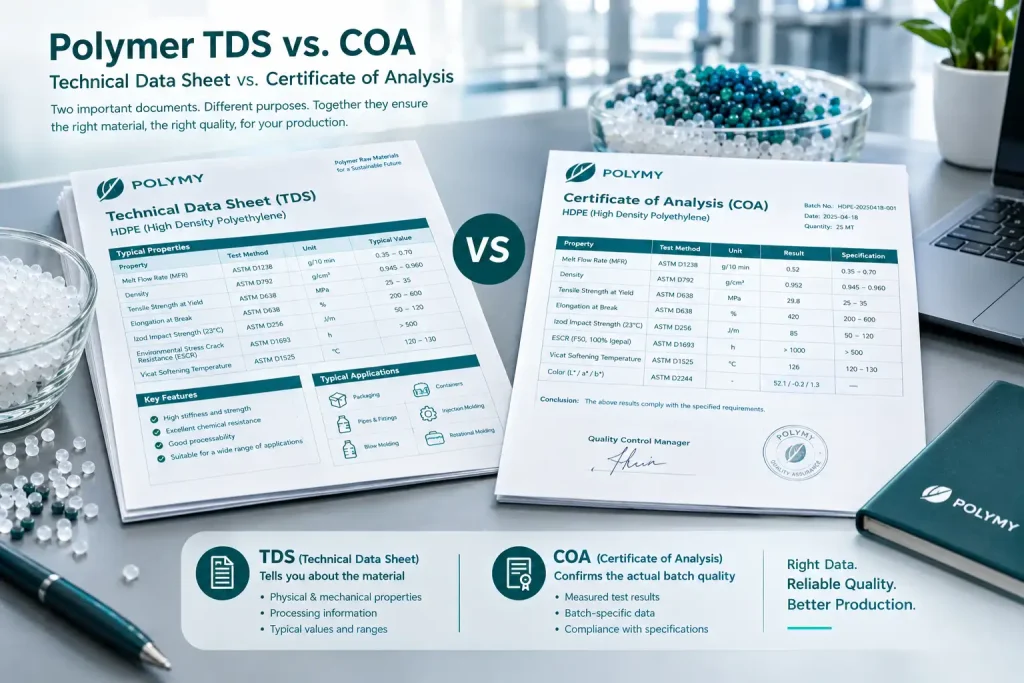
A Technical Data Sheet (TDS) and a Certificate of Analysis (COA) serve different purposes.
| Feature | TDS | COA |
| Main purpose | Describes typical technical properties and material characteristics | Reports test results for a specific batch or lot |
| Material identification | Usually identifies a polymer grade | Identifies the tested batch or lot |
| Test results | Often includes typical values or specified ranges | Includes results for the batch, according to the document |
| Common use | Grade selection and technical evaluation | Batch verification and quality control |
A TDS helps you determine whether a grade may be suitable for your application. A COA helps you evaluate the reported results for a particular batch.
Neither document should be assumed to replace all other required quality, regulatory, or product compliance documentation.
For international polymer purchases, buyers should confirm which documents are available and what information they contain before finalizing an order.
How to Compare Two Polymer TDS Documents
When comparing two polymer grades, avoid focusing on a single number. Instead, evaluate the properties relevant to your application.
Follow these steps:
Step 1: Confirm the polymer type and grade.
Check whether both materials are HDPE, LDPE, LLDPE, PP, PS, or another polymer, and identify their intended applications.
Step 2: Check the MFI test conditions.
Compare melt flow rate values only when the test temperature, load, and method are comparable.
Step 3: Compare density and mechanical properties.
Review density, tensile properties, elongation, impact strength, and stiffness where relevant.
Step 4: Evaluate thermal and processing requirements.
Check whether the grade is suitable for your equipment and manufacturing process.
Step 5: Review the test standards.
Make sure the reported properties were measured using comparable methods.
Step 6: Confirm quality documentation.
Ask whether the supplier can provide the current TDS and a COA for the supplied batch.
Step 7: Test the material if necessary.
For critical applications, conduct production trials and appropriate laboratory testing before approving a new grade for regular use.
The best polymer grade is not necessarily the one with the highest value in every category. It is the grade that meets the technical and commercial requirements of the intended application.
Common Mistakes When Reading a Polymer TDS
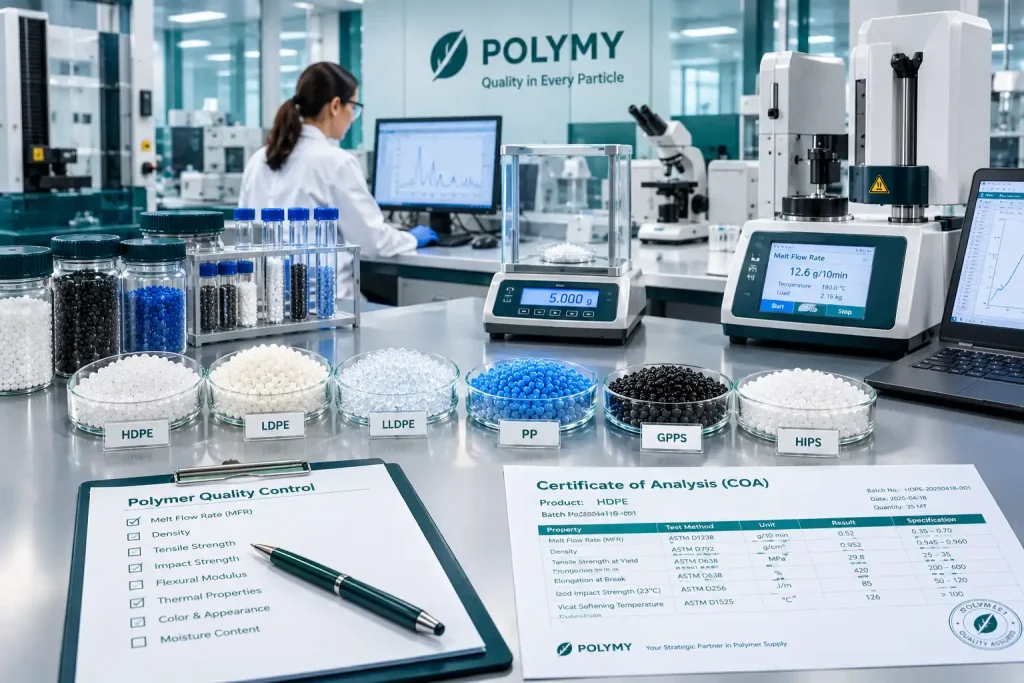
Even experienced buyers can misinterpret technical data sheets. The following mistakes are worth avoiding:
1. Comparing MFI values under different test conditions
Always check temperature, load, and test method before comparing flow values.
2. Assuming typical values are guaranteed
Confirm whether each property is typical, specified, or contractually guaranteed.
3. Selecting a material based on one parameter
MFI, density, or tensile strength alone cannot establish overall suitability.
4. Ignoring the intended application
A grade developed for injection molding may not be the right choice for film extrusion or pipe production.
5. Treating laboratory results as complete proof of performance
Actual performance also depends on processing, product design, additives, and operating conditions.
6. Ignoring the difference between TDS and COA
A TDS generally describes the grade, while a COA reports results associated with a specific batch.
7. Using outdated or incomplete documents
Ask the supplier to confirm that the document applies to the exact grade being offered.
How POLYMY Can Help You Select the Right Polymer Grade
Choosing the right plastic raw material requires more than comparing prices. Buyers should consider technical specifications, processing requirements, product performance, documentation, and supply conditions.
At POLYMY, we work with industrial polymer materials and support buyers seeking suitable grades for their manufacturing requirements. Our product range includes virgin polymer raw materials such as HDPE, LDPE, LLDPE, polypropylene, and polystyrene, as well as compounds and masterbatches.
When evaluating a polymer grade, buyers should review the relevant technical documentation and confirm that the material matches their intended application.
If you are sourcing polymer raw materials for your business, visit the POLYMY website to explore available products and contact our team about your requirements.
Frequently Asked Questions (FAQs)
1. What does TDS mean in the plastics industry?
TDS stands for Technical Data Sheet. It provides technical information about a polymer grade, including selected physical, mechanical, thermal, and processing properties.
2. What is the most important parameter in a polymer TDS?
There is no single most important parameter for every application. MFI, density, tensile properties, impact strength, and thermal characteristics may all matter, depending on the product and manufacturing process.
3. What is the difference between MFI and density?
MFI measures the flow of molten polymer under specified test conditions. Density measures mass per unit volume. They describe different material characteristics and should not be used interchangeably.
4. Can I compare two polymer grades using their TDS documents?
Yes, provided you compare the correct properties and account for differences in test methods, conditions, and material applications.
5. Is a polymer TDS the same as a COA?
No. A TDS usually describes typical grade properties, while a COA reports test results for a specific batch or lot.
6. Does a higher MFI mean better polymer quality?
No. A higher MFI is not automatically better. The appropriate value depends on the polymer grade, processing method, and performance requirements.
7. Where can I get a TDS for a polymer grade?
You can request the current TDS from the material manufacturer or your supplier. Make sure the document identifies the exact grade you intend to purchase.
Conclusion
Learning how to read a polymer TDS helps manufacturers, engineers, and purchasing professionals make better-informed decisions when sourcing plastic raw materials.
By understanding MFI, density, tensile strength, elongation, impact strength, thermal properties, and test methods, buyers can compare grades more accurately and identify materials that meet their production requirements.
It is equally important to distinguish typical values from guaranteed specifications and to understand the difference between a TDS and a COA.
Before purchasing a polymer, review the technical documentation, confirm the intended application, and consult the supplier when specifications or test conditions are unclear.
Looking for polymer raw materials for your manufacturing business? Explore POLYMY’s product range at www.polymy.com and contact our team to discuss your requirements.