
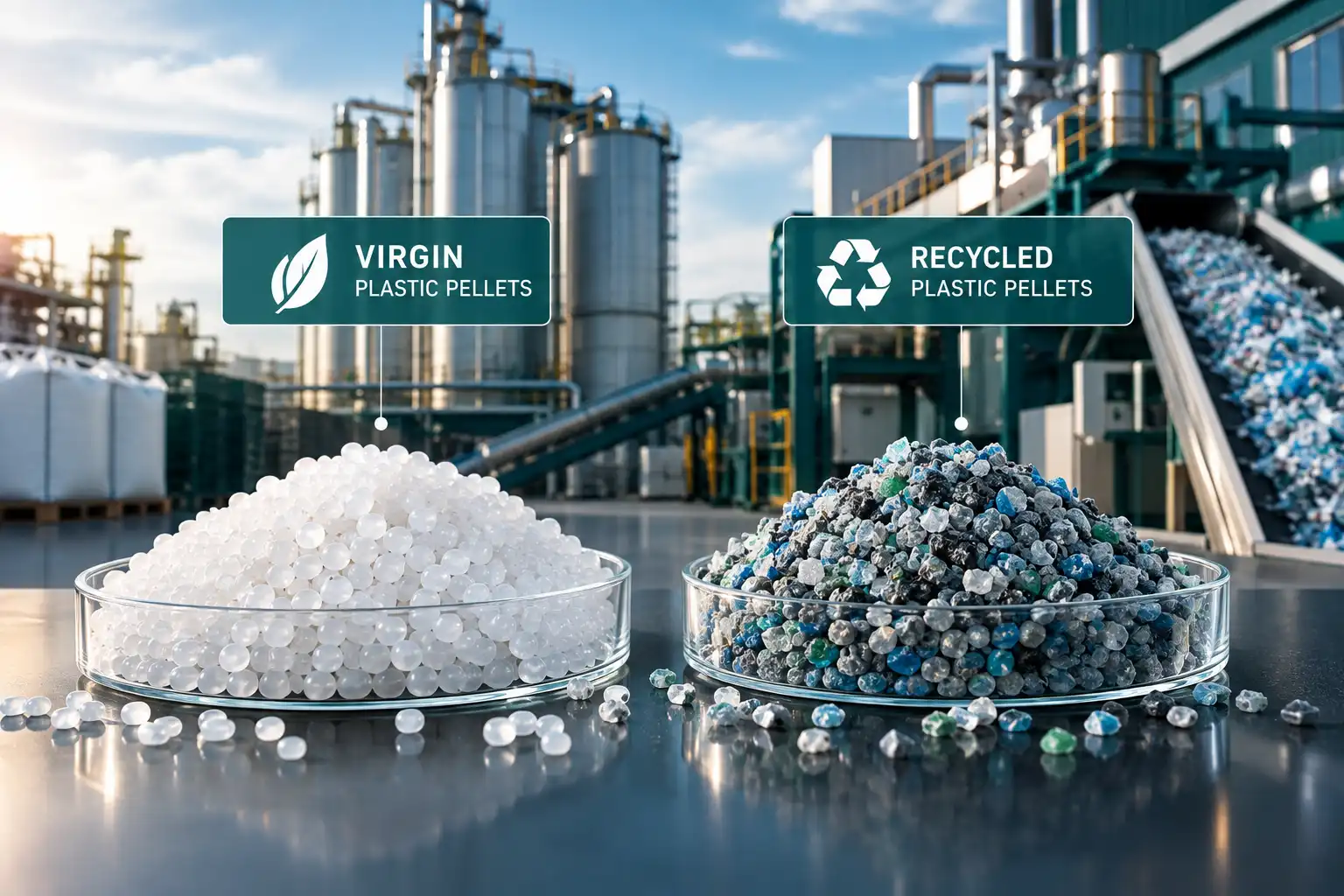
Virgin vs recycled plastic is an important consideration for manufacturers purchasing polymer raw materials. Both materials are widely used across packaging, construction, automotive, agriculture, consumer products, and industrial manufacturing.
Virgin polymers are produced from newly manufactured petrochemical feedstocks and have not previously been processed into a finished plastic product. Recycled polymers, on the other hand, are produced by processing plastic waste or previously used plastic products into material that can be used again.
The right choice depends on the required mechanical properties, consistency, appearance, regulatory requirements, application, sustainability targets, and total material cost. In this guide, we compare virgin plastic vs recycled plastic, explain their key differences, and examine when manufacturers may choose virgin or recycled polymer for industrial applications
What Is Virgin Plastic?
Virgin plastic is polymer resin produced from new raw materials without previous consumer or industrial use.
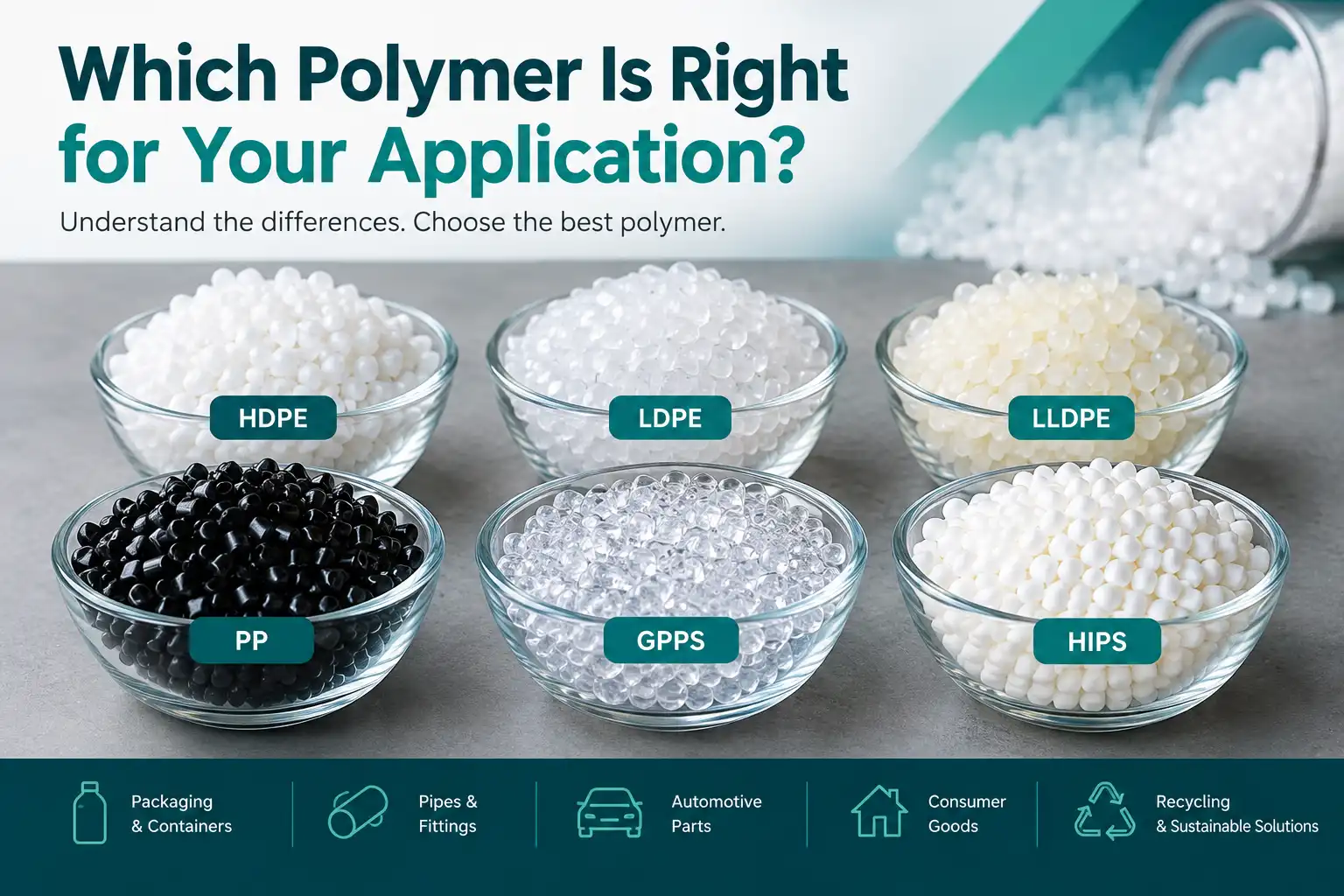
Common virgin polymers include:
- Virgin HDPE
- Virgin LDPE
- Virgin LLDPE
- Virgin Polypropylene (PP)
- Virgin GPPS
- Virgin HIPS
- Virgin PET
- Engineering plastics
Virgin polymer production typically begins with petrochemical feedstocks such as crude oil or natural gas. These feedstocks are processed into chemical intermediates and then polymerized to produce polymer resins.
The resulting material is generally supplied in controlled pellet or granule form and can be compounded, colored, modified, or processed directly depending on the application.
Because the material has not previously undergone a complete product lifecycle, virgin resin provides manufacturers with a highly controlled starting material.
What Is Recycled Plastic?
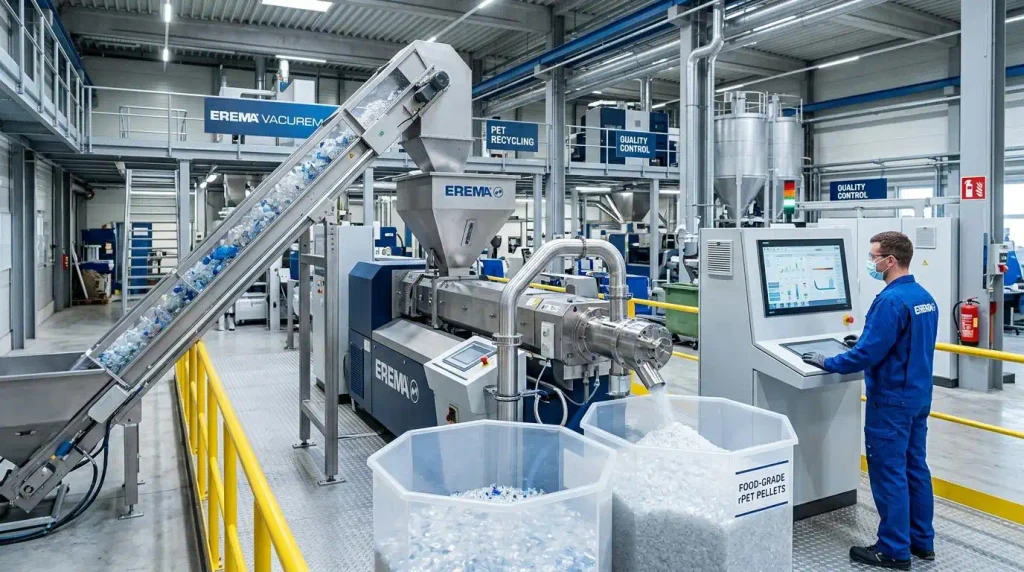
Recycled plastic is produced by recovering plastic waste and processing it into a material that can be used again.
Depending on the source, recycled polymers can include:
- Post-consumer recycled (PCR) plastic
- Post-industrial recycled (PIR) plastic
- Recycled HDPE
- Recycled LDPE
- Recycled LLDPE
- Recycled PP
- Recycled PET
- Recycled PS
- Recycled ABS
The recycling process can involve collection, sorting, cleaning, shredding, washing, extrusion, filtration, pelletizing, and quality control.
The final properties of recycled resin depend strongly on the original material, contamination level, sorting quality, processing history, additives, and recycling technology.
This means that two recycled materials carrying the same polymer family name may not necessarily have identical performance.
Virgin vs Recycled Plastic: Key Differences
The main difference between virgin and recycled plastic is the material’s processing history.
| Property | Virgin Plastic | Recycled Plastic |
| Raw material history | Newly produced polymer | Previously processed/recovered material |
| Consistency | Generally highly consistent | Can vary depending on feedstock |
| Mechanical properties | Predictable within grade specification | Can vary by source and processing |
| Color | Wide range and controlled | May be more limited depending on feedstock |
| Contamination risk | Low when properly manufactured | Depends on collection and processing |
| Traceability | Usually straightforward | Depends on recycling system |
| Sustainability profile | Higher dependence on fossil feedstock | Supports material circularity |
| Cost | Market-dependent | Market-dependent |
| Availability | Generally broad by grade | Depends on collection and recycling capacity |
| Application range | Very broad | Depends on quality and specification |
It is important to note that recycled plastic is not automatically cheaper than virgin plastic.
In 2026, recycled polymer prices and demand have been strongly affected by virgin resin prices, regulation, supply availability, and recycled-content requirements. S&P Global reports that recycled PE and PP markets remain sensitive to the price relationship with virgin materials and to quality and supply considerations.
Virgin Plastic: Advantages for Industrial Manufacturing
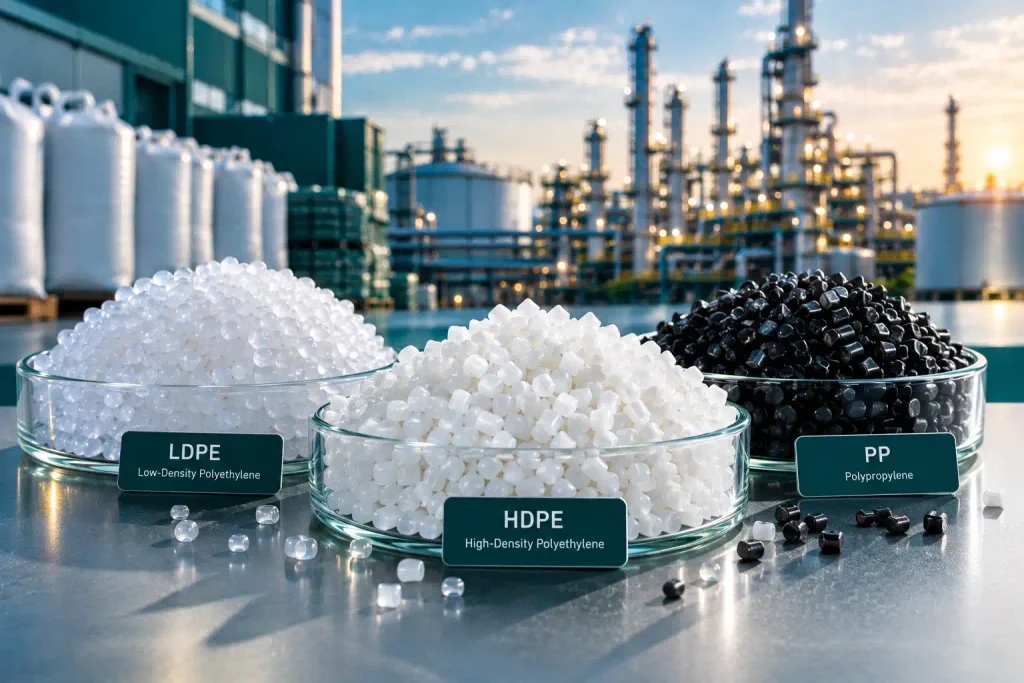
Virgin polymer is often selected when manufacturers require tightly controlled and repeatable material properties.
1. Consistent Material Properties
Virgin resin is manufactured to a defined grade specification.
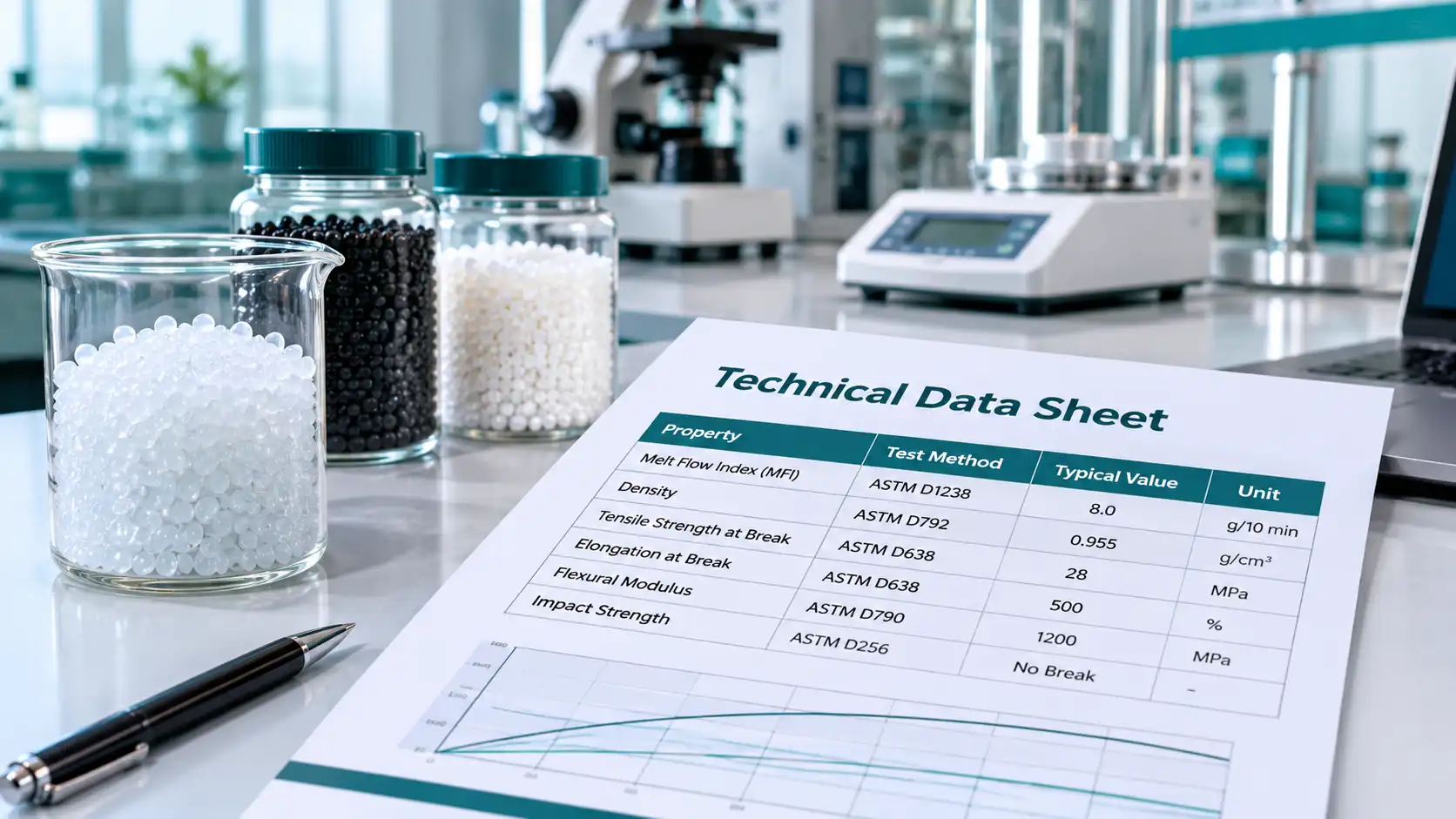
Depending on the polymer and producer, technical parameters can include:
- Melt flow rate
- Density
- Tensile strength
- Elongation
- Impact strength
- Flexural modulus
- Thermal properties
This consistency can make process optimization easier for manufacturers.
2. Predictable Processing
Virgin resin generally provides a more predictable processing window because the material has not previously experienced multiple thermal and mechanical cycles.
This can be particularly important for high-volume manufacturing.
3. Controlled Appearance
Virgin polymer can provide consistent color, transparency, surface finish, and appearance when the appropriate grade and formulation are selected.
This is important for products where appearance is a major commercial requirement.
4. Wide Grade Selection
Virgin polymers are available in grades designed for specific manufacturing processes, including:
- Injection molding
- Blow molding
- Film extrusion
- Pipe extrusion
- Rotational molding
- Extrusion coating
- Thermoforming
Manufacturers can therefore select a grade based on the specific processing requirements of their product.
Recycled Plastic: Advantages for Industrial Applications
Recycled polymers can provide important benefits when the material meets the required technical specification.
1. Supports Circular Material Use
Using recycled polymers can help return previously used plastic material into manufacturing instead of relying entirely on newly produced resin.
This is one reason recycled content is becoming increasingly relevant in industrial procurement and sustainability strategies.
2. Potential Reduction in Virgin Material Demand
Replacing part of a virgin polymer formulation with suitable recycled content can reduce the amount of new polymer required.
The feasibility depends on the application and required performance.
3. Suitable for Many Non-Critical Applications
High-quality recycled polymers can be suitable for applications where extremely tight virgin-grade specifications are not necessary.
Examples may include:
- Industrial bins
- Pallets
- Waste containers
- Construction products
- Agricultural products
- Non-food packaging
- Industrial components
The appropriate application depends on the recycled material’s actual specification.
4. Growing Regulatory Importance
Recycled-content requirements are becoming increasingly important in several markets.
Current global market analysis indicates that regulations and recycled-content mandates are supporting demand for certain high-quality recycled polymers, although adoption remains uneven between regions and polymer types.
Virgin vs Recycled Plastic: Mechanical Properties
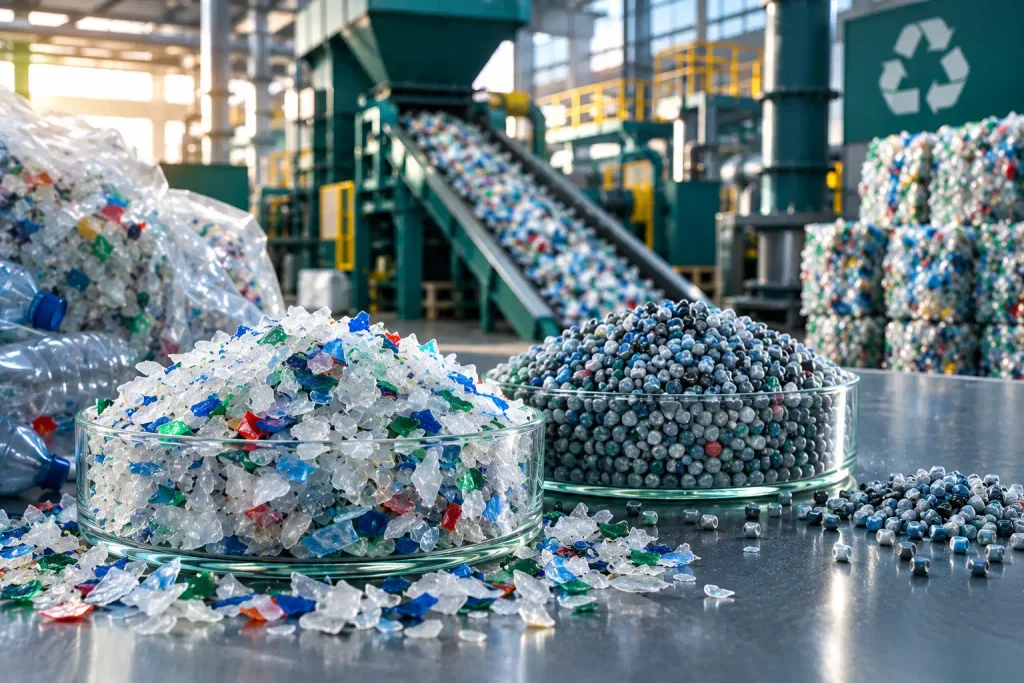
Mechanical performance is one of the most important considerations when comparing virgin and recycled polymers.
Recycling involves additional thermal and mechanical processing. Depending on the polymer, processing conditions, additives, contamination, and number of previous processing cycles, this can influence properties.
However, it is incorrect to assume that every recycled polymer has poor mechanical performance.
The actual result depends on the quality of the recycled feedstock and the recycling process.
For example, research on recycled PP, HIPS and ABS systems has demonstrated that recycled materials can retain useful mechanical properties, while some properties such as elongation can change compared with virgin material.
Therefore, industrial buyers should evaluate the actual TDS and COA of the recycled grade rather than judging it only by the word “recycled.”
Virgin vs Recycled HDPE
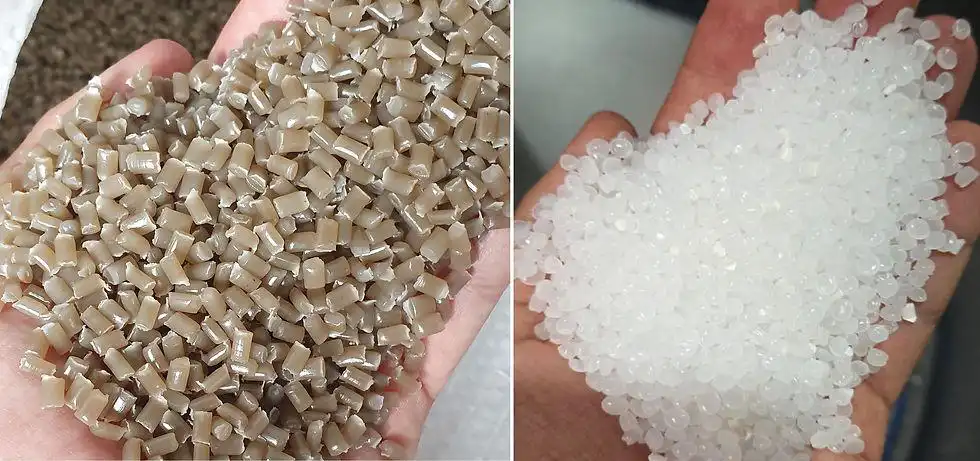
HDPE is one of the most important polymers for industrial applications.
Virgin HDPE
Virgin HDPE is widely used for:
- Water and gas pipes
- Bottles
- Containers
- Industrial tanks
- Blow-molded products
- Injection-molded components
- Film
- Rotational molding
Virgin HDPE provides manufacturers with controlled grade specifications and a wide selection of specialized grades.
Recycled HDPE
Recycled HDPE can be used for applications such as:
- Waste bins
- Pallets
- Containers
- Industrial products
- Construction products
- Agricultural products
- Non-food packaging
The suitability depends on the source and quality of the recycled HDPE.
For applications requiring strict pressure, food-contact, or critical mechanical performance, manufacturers must verify that the recycled grade meets the applicable requirements.
Virgin vs Recycled Polypropylene
Polypropylene is another major industrial polymer.
Virgin PP is widely used for:
- Automotive components
- Household products
- Packaging
- Injection molding
- Fibers
- Nonwoven products
- Industrial components
Recycled PP can also be used in many industrial applications where its technical specification is appropriate.
Potential applications include:
- Automotive components
- Industrial parts
- Storage products
- Household products
- Pallets
- Non-food packaging
Again, the correct choice depends on the required mechanical, thermal, appearance, and processing properties.
When Should Manufacturers Choose Virgin Plastic?
Virgin plastic may be appropriate when the application requires:
High and predictable performance
Critical components may require tightly controlled mechanical and thermal properties.
Consistent production
Large-scale manufacturers often need consistent melt flow and processing behavior from batch to batch.
Strict appearance requirements
Products requiring controlled color, transparency, gloss, or surface finish may favor virgin material or a carefully formulated blend.
Regulatory compliance
Certain applications have strict requirements regarding material composition, traceability, or contact with food, drinking water, pharmaceuticals, or other regulated products.
The manufacturer must verify the specific regulatory requirements applicable to the final product and destination market.
Specialized polymer grades
Some highly specialized applications require a particular virgin resin grade that may not have an equivalent recycled grade with the necessary specification.
When Can Recycled Plastic Be Used?
Recycled plastic can be considered when:
- The application permits recycled content
- The recycled grade meets the required specifications
- The feedstock is properly controlled
- The manufacturer can maintain consistent processing
- Appearance requirements are compatible with the material
- Applicable regulations allow its use
- The buyer’s sustainability objectives support recycled content
A recycled material should therefore be evaluated based on performance and specification, not simply its recycled status.
Virgin and Recycled Plastic Blends
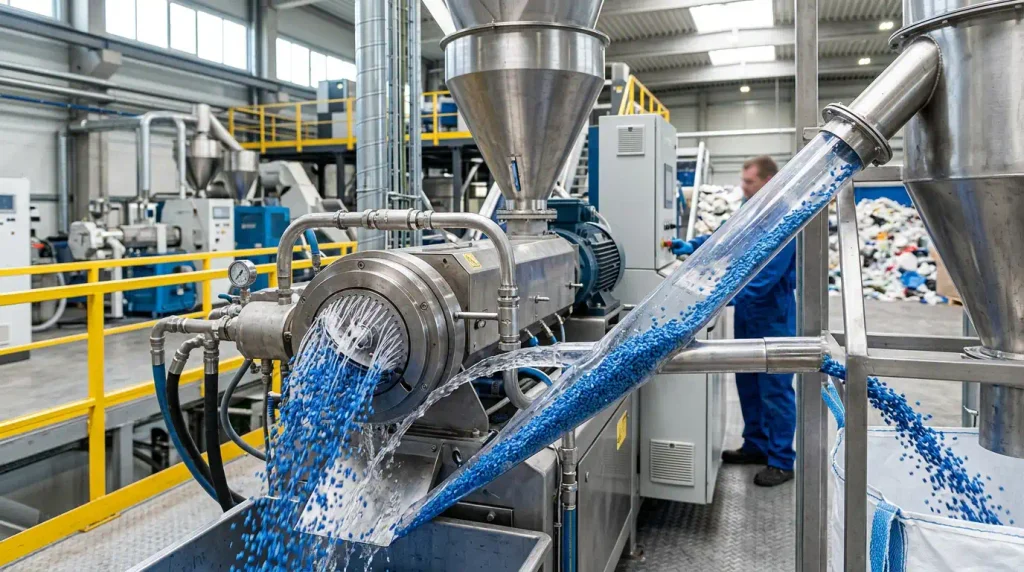
Manufacturers do not always have to choose between 100% virgin and 100% recycled material.
In some applications, virgin and recycled polymers can be blended.
For example:
Virgin polymer + recycled polymer + additives
can potentially provide a balance between:
- Performance
- Cost
- Material efficiency
- Recycled content
- Processing requirements
However, blend ratios should be established through technical testing.
Compatibility, melt flow, contamination, color, thermal stability, mechanical properties, and final-product requirements should all be evaluated.
Virgin vs Recycled Plastic Cost
Price is one of the most important factors in polymer procurement, but the relationship between virgin and recycled resin prices changes over time.
Recycled polymers have historically been influenced by their price spread against virgin resin. When virgin resin becomes less expensive, recycled material can lose some of its economic attractiveness. When virgin supply becomes tighter or more expensive, recycled materials can become more competitive.
S&P Global’s 2026 market analysis highlights this relationship and notes that recycled PE and PP markets remain particularly exposed to changes in virgin polymer prices.
Therefore, buyers should compare total production economics, rather than assuming recycled resin will always have a lower purchase price.
The calculation can include:
- Material price
- Transportation
- Processing efficiency
- Scrap rate
- Additive requirements
- Quality-control costs
- Availability
- Regulatory requirements
- Production losses
How to Choose Between Virgin and Recycled Plastic
A practical material-selection process should begin with the final product rather than the resin price.
Step 1: Define the Application
Identify exactly what the plastic product will be used for.
Step 2: Define Required Properties
Determine the required:
- MFI
- Density
- Tensile strength
- Impact strength
- Elongation
- Thermal resistance
- ESCR
- UV resistance
Step 3: Determine Regulatory Requirements
Check whether the product is subject to food-contact, drinking-water, construction, automotive, packaging, or other regulatory requirements.
Step 4: Compare TDS and COA
Request technical documents from both virgin and recycled suppliers.
Step 5: Conduct Production Trials
For a new recycled grade, production trials can help verify:
- Processing behavior
- Surface finish
- Mechanical performance
- Dimensional stability
- Color consistency
- Production yield
Step 6: Calculate Total Cost
Compare the complete manufacturing economics rather than only the resin purchase price.
What Should Industrial Buyers Check When Purchasing Recycled Polymer?
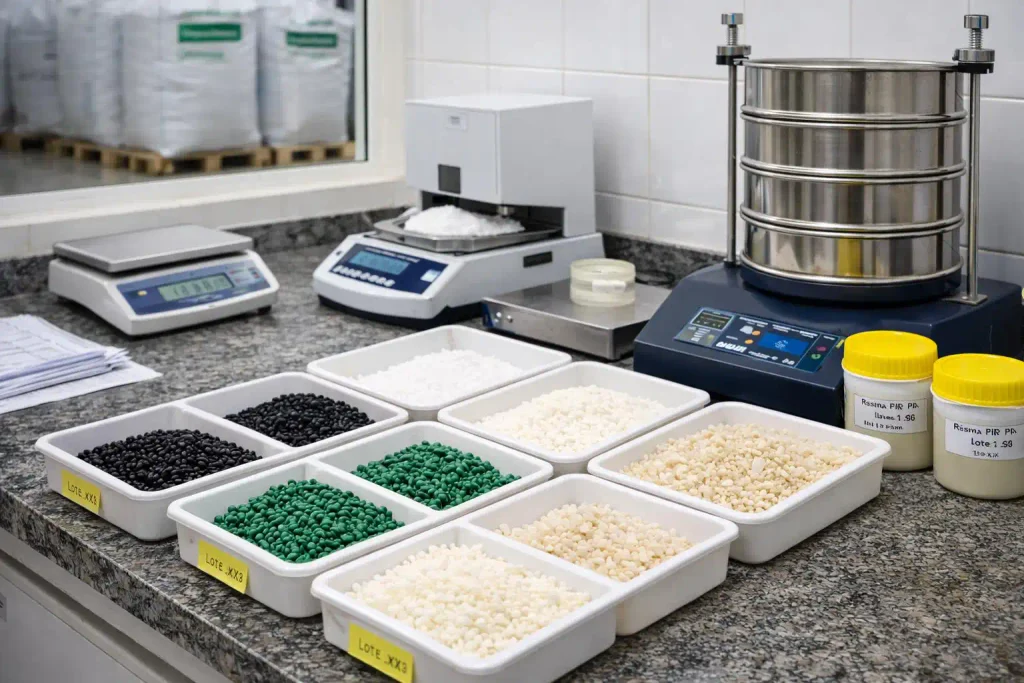
Quality control is particularly important when purchasing recycled materials.
Buyers should consider requesting:
- Technical Data Sheet (TDS)
- Certificate of Analysis (COA)
- Material origin
- Polymer identification
- MFI
- Density
- Moisture
- Ash content
- Contamination level
- Color specification
- Additive information
- Batch information
- Relevant certification
For specialized applications, additional testing may be necessary.
A supplier’s ability to provide consistent batch-to-batch documentation can be just as important as the quoted price.
Virgin vs Recycled Plastic for Export Buyers
International buyers should consider additional factors when sourcing polymer materials.
These include:
- Country of origin
- Supplier reliability
- Production capacity
- Consistency between shipments
- Packaging
- Export documentation
- Incoterms
- Shipping costs
- Lead time
- Payment terms
- Technical support
For virgin polymer, buyers may focus heavily on the specific petrochemical grade and producer.
For recycled polymer, additional attention should normally be given to feedstock origin, sorting, processing technology, contamination control, certification, and batch consistency.
The Future of Virgin and Recycled Polymers
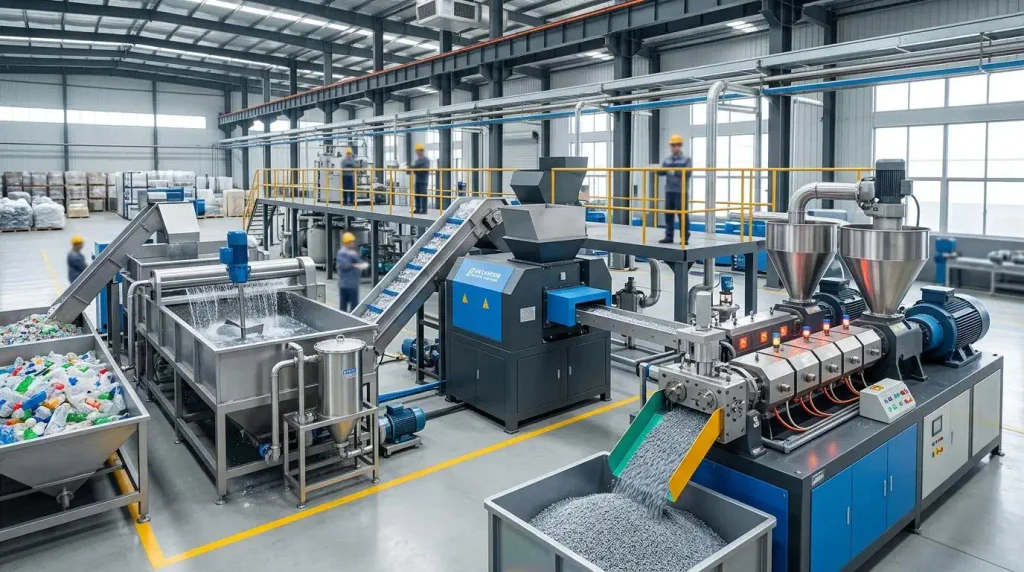
The global polymer market is increasingly moving toward a model in which virgin and recycled materials coexist rather than one completely replacing the other.
Current market developments are being influenced by:
- Recycled-content regulations
- Corporate sustainability targets
- Polymer pricing
- Feedstock availability
- Recycling capacity
- Quality requirements
- Supply-chain security
- Circular-economy policies
S&P Global’s 2026 analysis describes recycled polymer markets as being at an important transition point, with regulation, supply-chain conditions and the price relationship between virgin and recycled materials influencing demand.
For industrial manufacturers, this means material selection is becoming increasingly application-specific.
Frequently Asked Questions
Is virgin plastic better than recycled plastic?
Not universally. Virgin plastic generally offers highly controlled and predictable material properties, while high-quality recycled plastic can provide suitable performance for many applications. The appropriate choice depends on the product requirements.
Is recycled plastic cheaper than virgin plastic?
Not always. Prices change according to polymer type, region, feedstock availability, recycling capacity, regulation, and virgin-resin prices.
Is recycled HDPE as strong as virgin HDPE?
It depends on the recycled material and its processing history. High-quality recycled HDPE can provide useful mechanical performance, but properties should be verified using the supplier’s technical documentation and testing.
Can virgin and recycled plastic be mixed?
Yes, virgin and recycled polymers can be blended in some applications. The appropriate ratio depends on compatibility, processing conditions and required final-product properties.
Which is better for industrial applications: virgin or recycled polymer?
There is no single answer. Critical applications may require the consistency and specification control of virgin resin, while other industrial applications may be suitable for high-quality recycled materials.
What is the difference between PCR and PIR plastic?
PCR means Post-Consumer Recycled, referring to plastic recovered after consumer use.
PIR means Post-Industrial Recycled, referring to material recovered from industrial manufacturing processes before or around the point of reaching the consumer.
Should I request a COA when buying recycled polymer?
Yes. A current COA can help verify important batch-specific parameters such as MFI, density and other agreed specifications.
Can recycled polymer be used for packaging?
It depends on the type of packaging, polymer, recycled content, contamination control, certification and applicable regulations. Food-contact applications generally have more stringent requirements than many non-food applications.
Conclusion
The comparison between virgin vs recycled plastic is not simply a question of which material is better.
Virgin polymers provide manufacturers with highly controlled and predictable material properties and remain essential for many demanding industrial applications. Recycled polymers, when produced to appropriate specifications, can provide useful performance while supporting greater circular use of plastic materials.
The right choice depends on the application, required mechanical properties, processing conditions, appearance, regulatory requirements, supply availability and total production economics.
For industrial buyers, the most effective approach is to compare technical specifications, COA data, application requirements and total cost rather than selecting a material based only on whether it is virgin or recycled.
As global regulations, sustainability requirements and polymer-market conditions continue to evolve, both virgin and recycled polymers will remain important parts of the international plastics supply chain.
POLYMY supplies virgin polymer raw materials, polymer compounds and masterbatches for international manufacturers and buyers, supporting sourcing requirements across multiple industrial applications and global markets.